
Part One
From the publisher
Publisher's note
LeadNBFI is a marketing firm that works with financial companies, M&A advisory firms among them. We are open about that interest: a market that takes its public evidence seriously is good for us. It is also, we believe, good for the firms in it — and that belief is checkable against the research in these pages, not something we ask you to take on trust.
This report began with a question we kept meeting in our own work. M&A advisory is a referral business, and everyone in it knows that. Yet between the referral and the first conversation something has changed. The people a firm is introduced to now look before they call — and so do the people who make the introductions, and so do the search and AI systems that increasingly sit between the two. What they all find is the firm's public record. Nobody in the industry seemed to know, with any precision, what that record actually shows.
So we measured it. Forty-eight US M&A advisory firms, twenty-seven questions each, the same questions for every firm, against public evidence as of August 31, 2026. Before publication, we sent every firm named in the report its own draft record and invited it to correct any factual error. No firm is scored, ranked or compared with another. Where something was not observed, the report says exactly that — not observed — because a public record is evidence of what is visible, never of what a firm is capable of.
The result is not flattering to the sector, and it is not damning either. It is specific. We think specific is what a managing partner can actually use.
— LeadNBFI, October 2026
Chapter one
Before the first call: the verification nobody sees
A name comes up in a board meeting. Someone writes it down. And then, before anyone picks up the phone, somebody looks.
The look is short. It happens on a phone as often as at a desk, and it is increasingly mediated by a search engine's summary or an AI assistant's answer rather than by a patient read of the firm's own pages. What it returns is not the firm's reputation. Reputation lives in people's heads, in closed deals, in twenty years of relationships. What the look returns is the firm's public record: the one part of its standing that a stranger can inspect without an introduction, an engagement letter or a phone call.
This report is about that record — what it shows for 48 US M&A advisory firms, where it substantiates the introduction, and where it leaves a reader with questions the firm could easily have answered.
A public presence does not replace reputation or referrals. It is the record that prospective clients and referral sources can inspect before the first conversation.
The premise, stated as a premise
This report treats M&A advisory as a referral-led market. That is practitioner consensus and market structure, not a measured finding — as of the literature search behind this report (September 18, 2026, updated October 5, 2026), we identified no published study that measures how owners of US lower-middle-market companies actually find their advisers, and the honest position is to say so.[1] The argument that follows is conditional on that premise, and it is the only thing in this report we ask the reader to grant.
Grant it, and a specific picture follows. An introduction used to end the owner's search: a trusted name, a phone call, a meeting. It now starts a quieter process that the firm never sees. Three readers work through that process, each with a different question.
The owner asks: is this firm for someone like me? The referral partner — the accountant, the attorney, the wealth adviser whose own name travels with the introduction — asks: what will my client find when they look? And the retrieval system, asked to explain or recommend, assembles an answer from whatever public text it can find and attribute. None of the three announces themselves. The firm only ever meets the ones who were satisfied.
Between the mention and the call
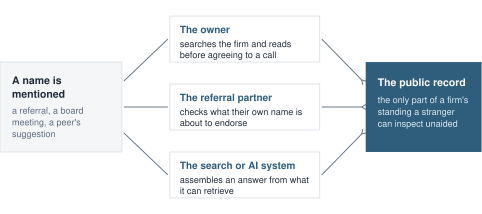
What the adjacent evidence shows
How often does the quiet process end a candidacy? For M&A advisory specifically, we identified no study that has measured it. The nearest evidence comes from professional services generally, and it should be read with its provenance attached: the most-cited study was published in 2015 by a research institute that sells marketing programs to the firms it surveyed. With that stated — in a survey of 523 professional-services firms, 52 percent of respondents said they had ruled out a referred firm before ever speaking with it. The leading reason was not an ugly website. It was comprehension: 44 percent could not understand how the firm could help them, well ahead of material that felt sales-led rather than helpful at 33 percent, poor cultural fit at 31 percent, and an unimpressive website at 30 percent. Only 16 percent cited failing to find the firm in search at all.[3]
The same publisher's study of the referral supply side surveyed 262 advisers in the private-company transition community — accountants, attorneys, wealth planners, consultants, and, at 13 percent of the sample, M&A intermediaries, the closest sampled proxy to this market we know of. Among them, visible expertise was the single factor most likely to increase the probability of making a referral, accounting for 27 percent of the referral drivers respondents identified, and its absence topped the list of referral killers at 46 percent.[4] Separately, in the publisher's 2015 survey, 82 percent of firms said they had received a referral from someone who was never a client, resting on expertise and reputation rather than direct experience.[3]
Two cautions travel with those numbers. Both studies are self-report — what people say they do, which observational research reliably finds is not quite what they do. And both come from one publisher with a commercial interest in the conclusion. This report quotes them anyway, for a simple reason: they are the best available description of a behavior every reader of this report has personally performed. You looked someone up this week. So did the people evaluating you.
Three readers, three different questions
It is worth being precise about what each reader is trying to do, because they are not doing the same thing. The owner is running an elimination: with two or three credible names in hand, she is not looking for reasons to be impressed, she is looking for reasons to shorten the list — a size mismatch, a sector she cannot find, a page that reads like it was written for buyers of companies rather than sellers. The referral partner is running a risk check: his currency is his own judgment, and before he attaches his name to an introduction he wants the firm's public record to survive the ten minutes of looking his client will certainly do. The retrieval system is running neither — it is assembling text. It has no lunch history with the founder and no memory of the 2019 deal; it can only repeat, connect and attribute what is published. Three readers, one record, and the record answers all three or none.
What this report is, and is not
This report describes a locked sample of 48 US M&A advisory firms, identified through a public directory listing frame and screened against published eligibility rules. It is not a probability sample, not a census of the sector, and not a representative survey of US M&A advisory firms. Its findings describe what a defined public-evidence review located for these 48 firms, against 27 published indicators, on or before August 31, 2026. They do not describe the sector as a whole, and they do not describe any firm's quality, competence, conduct, regulatory standing, client outcomes or commercial performance.[2]
Two more boundaries, and they are load-bearing. First: where something was not observed, that is a statement about what is publicly visible, never evidence that the firm lacks the underlying capability. Several of the firms whose records show the widest gaps in this study are, by reputation and track record, among the most experienced in the sample — which is precisely why the distinction matters, and why this report will keep making it. Second: nothing in this report claims that public visibility wins mandates. We know of no evidence that it does, and the design of a study like this one could not establish it. What the evidence supports is narrower and, for a practical reader, more useful: the public record is read before any conversation happens, by owners and by the advisers who refer them, and its downside — being quietly ruled out — is considerably better evidenced than its upside.
Before publication, LeadNBFI sent every firm named in this report its own draft record and invited it to identify factual errors and supply qualifying public material the review had missed. All 48 appear by name, alphabetically, in Part Two of this report, under the identical framework. No firm is scored, ranked or compared with another anywhere in this publication.
Survey figures: Hinge Research Institute, Referral Marketing for Professional Services Firms (2015), n=523, multi-select responses; XPX and Hinge, Referral Marketing Study, n=262, undated document. Both from the same publisher; see Notes and sources. Benchmark scope: 48 firms, 27 questions, evidence to August 31, 2026.
Chapter two
The sector in seven numbers
Before the argument, the shape of the evidence. Seven results, each from the same 48 firms, each answering a question a stranger with a shortlist might ask. Read down the list and watch what happens.
- 100%Every firm can be contacted within two clicks of its homepage.48 of 48 firms
- 96%Nearly every firm names the sectors it serves.46 of 48 firms
- 79%Most show a completed sale where the firm acted for the seller.38 of 48 firms
- 46%Fewer than half carry a dedicated page that explains one of those sectors.21 of the 46 firms with a valid result
- 38%Just over a third published owner-facing education in the ninety days before the cutoff.18 of the 47 firms with a valid result
- 36%Barely a third show a named adviser authoring educational material within the year.17 of the 47 firms with a valid result
- 0 of 44No firm links an adviser's biography to that adviser's own published work.44 firms with a valid result; 4 could not be verified
The pattern is not subtle. The things every firm does are the things that announce a firm: a website, a contact route, a list of sectors, a deal history. The things few firms do are the things that let a stranger verify expertise without asking: an explanation, a current voice, a named author, a path from a person to that person's thinking. The sector has built the storefront and left the evidence in the back room.
The market is visible. Much of its expertise is not.
All seven results from the 2026 review of 48 firms against public evidence available by August 31, 2026. Where a firm's result could not be verified, it is excluded from the rate rather than counted against the firm; denominators above show the firms with a valid observation for each question.
Chapter three
The M&A Adviser Verification Gap
The pattern in the seven numbers deserves a name, because naming it is what makes it discussable at a partners' meeting.
The M&A Adviser Verification Gap: the distance between the expertise a firm possesses and the evidence an outsider can find, understand and attribute to it.
The gap is not about having a website. Every firm in this study has one, and most are professionally built. It is the distance between claim and evidence — between naming a sector and explaining it, between listing advisers and letting a reader verify what those advisers know, between showing that deals closed and showing what the firm actually did for the seller. Stack the review's questions from easiest to hardest to verify, and the sector's public record thins in a strikingly consistent way.
The Verification Gap, in one chart
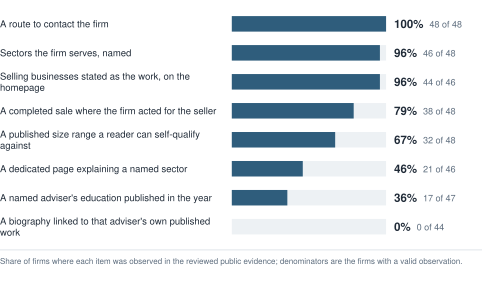
At the top of the ladder, the record is nearly complete: every firm is reachable, and nearly every firm says what it does and names the industries it works in. These are the claims. Descend toward evidence — the size range that lets an owner self-qualify, the page that proves the firm understands an industry it names, the named adviser whose thinking is published and current — and coverage falls from near-universal to a minority. At the bottom sits the study's cleanest result: among the 44 firms whose adviser pages could be fully reviewed, not one links a biography to something that adviser has personally written or presented. The claim of expertise is everywhere. The chain a stranger could follow to check it, almost nowhere.
Why able firms have wide gaps
It would be easy to read the gap as neglect. The more accurate reading is that it is inherited. These firms grew up in a market where the referral genuinely was the credential — where by the time an owner heard your name, the trust question was already settled by whoever said it. Under that regime, publishing evidence was optional, confidentiality made discretion feel professional, and partner time spent writing was partner time not spent on live mandates. Every one of those instincts was reasonable. The environment moved: the referral still opens the door, but the people behind the door now check — and the checking is done by strangers and, increasingly, by software, neither of which can be vouched for over lunch.
There is also a structural reason the gap matters more in this market than in most. Selling a company is close to what economists call a credence good: the owner cannot fully judge the quality of the advice even after the deal closes, because the outcome under a different adviser is never observed.[5] That framing is this report's own inference, not a finding from the study — but it explains what every intermediary already knows from practice. Buyers of un-checkable services lean hard on what they can check: who you are, what you have done, what you demonstrably understand, and whether any of it is visible before the meeting. In a market of excellent firms that all claim the same excellences, the checkable is what differentiates. Peer-reviewed research on adviser choice points the same direction — observable reputation and industry expertise are economically consequential in which advisers get retained — though that literature measures large, mostly public-company acquisitions from deal databases, and says nothing about websites.[6, 7, 8, 9]
Six signals, not a score
The 27 questions in this review were designed and locked before any firm was examined. To make the findings usable, this report reads them through six signals — six things a prospective client, a referral partner or a retrieval system is implicitly testing when they meet a firm's public record. The signals are an editorial lens, not a methodology: no firm is scored on them, there is no composite index, and no signal is weighted against another. They exist so that a managing partner can hold the findings in mind without memorizing 27 questions.
Six signals, one lens
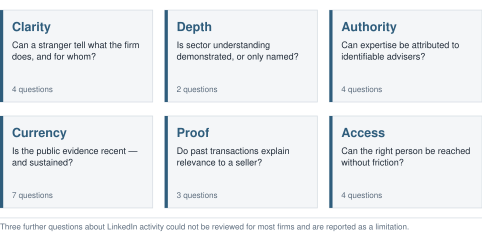
The six chapters that follow take the signals in turn. Each opens with what the review found, reads the pattern in commercial terms, is explicit about what the finding does not mean, and closes with what stronger public evidence looks like and a handful of actions a firm could take in a quarter without hiring anyone.
How to use this report
A suggestion on sequence, for a reader with limited time. Read the two signal chapters closest to your firm's current self-image — most partners already suspect where their record is thinnest, and the suspicion is usually right. Then read your own profile in Part Two of this report against the 27 questions in chapter twelve, in a private browser window, as a stranger would. Only then read the remaining chapters, which will have stopped being abstract. The 30/60/90 agenda at the back is written to be handed, as is, to whoever owns marketing — but the two or three decisions it surfaces, a published size range chief among them, belong in a partners' conversation first.
Signal one · Clarity
Plain about the work, quieter about the fit
Clarity is the cheapest signal in this report and the first one tested: within seconds of landing on a homepage, a reader knows whether they can tell what the firm does and whom it serves. On the first half of that test, the sector performs superbly. On the second, it goes quiet exactly where a prospective seller needs it to speak.
Almost every firm says what it does. Two in three let a reader work out whether they fit.
Stated work, quieter fit
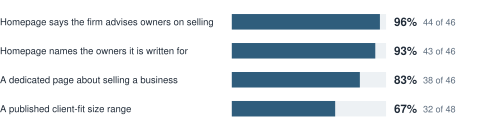
Start with what the sector does well, because it is genuinely well done. Among the 46 firms whose homepages could be fully reviewed, 44 say plainly that they advise owners on selling a business, and 43 name the audience they are writing for — owners, founders, families, shareholders. Sell-side advisory is not hiding behind the word 'solutions'. And 38 of those 46 firms give the sale of a business its own dedicated page rather than a paragraph inside a services list. A stranger rarely leaves one of these websites unsure what the firm is for.
The quiet part is fit. Sixty-seven percent of the 48 firms publish a numeric range a reader could qualify themselves against — revenue, EBITDA or enterprise value. The other sixteen firms publish none, which leaves every prospective seller who meets them online with the same unanswerable question: am I too small for these people, or too large, or exactly what they want? The reader cannot tell, and there is only one way to find out — make contact — which is precisely the step an undecided reader postpones.
Where the ambiguity costs
Recall the best-evidenced reason referred firms get ruled out before a first conversation: the reader could not understand how the firm could help them. In adjacent professional-services research, that reason outranked website quality by a wide margin.[3] A firm can be beautifully designed and still fail the comprehension test, because comprehension is not aesthetics — it is whether a specific owner, holding a specific company, can recognize themselves in the page. A stated size range does more of that work than any paragraph of positioning language, and it does the same work for the referral partner, who would rather not make an introduction that bounces, and for a retrieval system asked which advisers serve companies of a given size. Ambiguity feels safe inside the firm. Outside it, ambiguity reads as friction.
To be fair to the sixteen: a firm without a published range has not failed to define its market. Some ranges genuinely are wide; some firms flex for the right situation and do not want a number to talk them out of a conversation; a few may prefer the phone precisely because the phone converts. Those are defensible commercial choices. The observation of this chapter is only that the choice has a cost, the cost lands invisibly — in conversations that never start — and most firms have never priced it.
What stronger evidence looks like
A band, not a boast, placed where a first-time reader will meet it: a revenue or enterprise-value range on the homepage or the sell-side page, in the words owners use about their own companies. The strongest versions in this study pair the range with the audience — who the firm is for, and implicitly who it is not — so a reader can self-qualify in one glance, and a referral partner can pre-qualify in one forward.
Three actions for a quarter
- Publish the client-fit range, even a wide one, on the page a first-time reader actually lands on.
- Name the audience on the homepage in the owner's own words — founders, family businesses, private companies of a stated size — not in intermediary vocabulary.
- Give selling a business its own page if it does not have one, and let that page carry the range, the process and the invitation.
A reader who cannot tell whether they fit will rarely call to find out.
Basis: homepage sell-side language observed for 44 of 46 firms with a valid result; named owner audience 43 of 46; dedicated sell-side page 38 of 46; published client-fit range 32 of 48. Two firms' homepage items could not be verified and are excluded from those rates. Evidence to August 31, 2026.
Signal two · Depth
Sectors named, sectors explained
Ask any M&A adviser what wins the room and the answer is sector fluency: knowing the buyers, the multiples, the diligence traps, the reason processes in that industry run the way they do. The public record makes the claim constantly. It substantiates the claim rarely.
Naming a sector is not the same as explaining it.
From naming a sector to explaining one
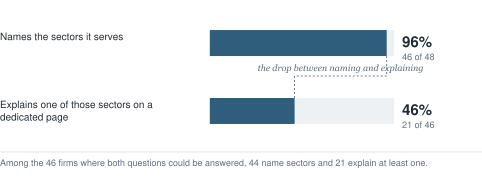
Sector naming is close to universal: 46 of the 48 firms name the industries they serve, usually as a list — eight, ten, fourteen words on a homepage or an about page. It is the cheapest credibility signal available, and nearly everyone has bought it. The next step up is where the record thins. A dedicated page that explains one named sector — at least two things true of that industry and not of every other, a buyer pattern, a valuation dynamic, a recurring diligence issue — was observed at 21 of the 46 firms with a valid result. Among the 46 firms where both questions could be answered, 44 name sectors and 21 explain at least one: fewer than half of the firms that make the claim give a stranger any way to check it.
The gap matters because of who is doing the checking. An owner holds three names, all referred, all credible, all listing her industry. The lists cannot separate the three firms, because the lists are identical. The explanation separates them — the page that says something about her industry that only someone who has transacted in it would say. The same asymmetry governs the machine reader: asked which advisers understand a given sector, a retrieval system can match a list-word, but it can only ground an answer in text that actually says something. A list is a claim to be checked. An explanation is the check.
What the 46 percent does not mean: that twenty-five firms lack sector depth. Many of the firms without a qualifying page have closed more transactions in their named sectors than firms with one, and a few plainly treat sector material as something the pitch meeting delivers in person. The measure here is visibility to a stranger, not competence — a firm can be excellent and illegible at the same time. It is worth saying that the underlying attribute is not in doubt: peer-reviewed research on adviser selection finds that industry expertise measurably shapes which advisers are retained, though that literature is built on large acquirer-side deals from deal databases and says nothing about what firms publish.[10] The one identified survey of US owners who completed a mid-market sale points the same way: reputation, industry expertise and track record led owners' stated reasons for choosing their bank — with the caveats that its 85 respondents were reached through the participating banks and that the single largest answer category was an unspecified 'other'.[11] The expertise is real and it is consequential. The question this chapter asks is narrower: can anyone outside the firm see it? The raw material mostly can be: 35 of the 48 firms already connect a seller transaction to a sector they name, so for most of this market the missing layer is explanation, not experience — chapter eight returns to that join.
What stronger evidence looks like
One page, one named sector, two or three things specific to it. The sector pages in this study that did the most work were not the longest; they were the ones a generalist could not have written. Which categories of buyer compete for these assets. What a typical process runs into at diligence. Where value concentrates, and why. Four hundred words is enough when the words are specific — the test is that a reader from that industry recognizes their own situation, and a reader from a different industry does not.
Three actions for a quarter
- Choose one sector — the one with the most completed sales, not the largest addressable market — and write its page.
- Put two things on it that are true of that sector and not of any other; retire the adjectives the page no longer needs.
- Link it from the sector list that already names it, so the claim and the evidence sit one click apart.
Basis: named sector coverage observed for 46 of 48 firms; dedicated sector depth for 21 of the 46 with a valid result. Joint subset: of 46 firms with both items valid, 44 name and 21 explain. Evidence to August 31, 2026.
Signal three · Authority
Credentialed people, unattributable expertise
Every firm in this study sells the same underlying asset: the judgment of its senior people. The biographies say so, at length and usually well. Then the trail stops.
Biographies are substantive. Almost none of them lead anywhere.
The attribution chain, and where it stops
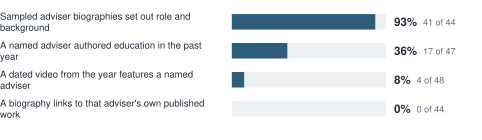
The base layer is strong. In the adviser pages sampled for each firm, 41 of the 44 firms with a reviewable roster present substantive biographies — current role plus real background, transactions led, sectors worked, prior careers. The claim of expertise is made properly and almost universally.
The evidence layer is thin. At 17 of 47 firms, a named current adviser authored or presented a piece of educational material within the year — an article with a byline, a recorded talk, a webinar with a face and a date. Four firms of the 48 have a dated video from the year featuring a named adviser. And the cleanest number in the study: of the 44 firms whose sampled biographies could be fully reviewed, the number whose biography links to anything that adviser has personally written or presented is zero. Not rare. Zero.
Read carefully, the zero is a statement about publishing architecture, not about people. Many of these advisers have written and spoken publicly — in trade press, at conferences, on panels; the material exists, scattered and unlinked. What no firm has built is the one-click chain from the person the introduction names to the thinking that would substantiate the introduction. The biography asserts; nothing on it lets a stranger verify. This is the Verification Gap at its most literal, and it is also the emptiest space in the sector's public record — the one place where doing a modest thing puts a firm, factually, in a category of one among these 48.
Who follows the chain
The owner does, sometimes: an introduction usually arrives with a person's name attached, and the person is what gets searched. The referral partner does it professionally — before an accountant sends their best client to 'talk to the partner who runs industrials', it helps if that partner visibly exists beyond a photograph and four paragraphs. And a retrieval system does it structurally: attribution is how such systems connect a claim to a source. A biography that links to its author's own dated work creates a chain a machine can follow; asserted seniority, however real, cannot be corroborated by software. That reasoning comes from the platforms' own published guidance, and it is reasoning rather than a measured effect — we identified no study that has tested it in professional services.[13] The human case alone carries this chapter.
What stronger evidence looks like
A biography that ends with three dated items the person authored: an article, a talk, a panel, each with a year, ideally each on a page the firm controls. Below it, a byline policy that survives contact with the next newsletter — the firm's insights carry the author's name, not 'Team'. None of this requires anyone to become a content personality; it requires the firm to connect material that mostly already exists to the people it already belongs to.
Four actions for a quarter
- Pick the three advisers who take first calls and end each biography with two or three dated items of their own work.
- Put a named byline on the next piece the firm publishes, and every piece after it.
- Date everything — an undated insight cannot demonstrate currency to anyone, human or machine.
- If one adviser is willing, record one two-minute explainer on a question owners actually ask, and put their name on the page.
Every firm says its people are the difference. No public page in this study lets a stranger check.
Basis: substantive sampled biographies at 41 of 44 firms with a valid result (4 could not be verified); named adviser authorship within the year at 17 of 47; adviser-featured dated video at 4 of 48; biography-to-own-work link at 0 of 44. Platform guidance on authorship and attribution: see Notes and sources. No individual is named or cited in this report. Evidence to August 31, 2026.
Signal four · Currency
The archive and the pulse
Most firms in this study have published something useful for owners. The question a stranger cannot help asking is quieter: is anyone still home?
Owner education exists. Evidence that it is current — and sustained — thins fast.
Owner education, as the question tightens
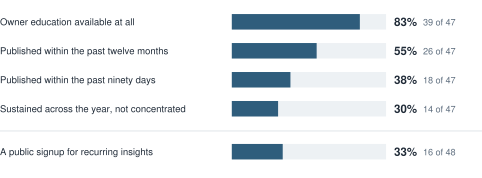
Eighty-three percent of the 47 firms with a valid result publish at least one substantive piece of owner-facing education: an article, a guide, a recorded session that actually teaches something about selling a company. The sector is not silent. But apply the reader's implicit follow-up questions and the number halves, then halves again. Published anything in the last twelve months: 26 of 47. In the last ninety days: 18 of 47. Sustained across the year rather than concentrated in one burst: 14 of 47. Under a third of the sector, on its own public record, is visibly and continuously present. A separate question — whether a reader can subscribe to hear from the firm again — lands in the same band: 16 of 48 offer a recurring-insights signup.
Two adjacent results sharpen the picture. The shelf exists: 41 of the 47 firms with a valid result keep a public collection of owner-facing material in one place, so the sector has somewhere to put what it writes. And the least-used format is the one owners increasingly reach for first: 11 of 48 firms offer an owner-topic educational video of at least two minutes. The infrastructure is common. The current, dated, human material inside it is not.
Why a reader cares about dates at all: the moment of verification is a moment of inference. A page of insights whose newest item is three years old does not say 'this firm is bad at its work' — but it forces a stranger to guess what it does say. Did the team change? Did the firm drift out of this market? Is anyone reading the inbox? The owner cannot ask, the referral partner would rather not explain, and a retrieval system asked for current perspectives has nothing dated to retrieve. Currency is the cheapest signal of presence there is, and it decays by default.
The necessary caution runs the other way too. Publishing cadence is not a proxy for quality of advice, and this report does not treat it as one. A firm that publishes two substantive pieces a year, dated and attributed, is more useful to an owner than one that posts weekly filler — volume is the most gameable metric in marketing, which is exactly why this review measured windows and spread rather than counts. Fourteen firms clearing the sustained bar is not an instruction to the other thirty-three to start a blog. It is evidence about how rare a visible, steady pulse currently is — and therefore how little it takes to have one of the more current records in this market.
What stronger evidence looks like
Four dated items spread across the year, each answering a question owners genuinely ask — what my business is worth in this market, what diligence will surface, when to tell my team, what earnouts actually pay. A visible date on every item. A working signup for the next one. That is the whole bar, and two-thirds of this market is currently under it.
Three actions for a quarter
- Put a visible publication date on everything already published — an afternoon's work that upgrades the whole archive.
- Calendar four items for the coming year, one per quarter, each answering one real owner question.
- Open a recurring-insights signup and route it somewhere a human actually monitors.
An archive proves a past. A cadence suggests a present.
Basis, firms with a valid result: owner education available 39 of 47; within twelve months 26 of 47; within ninety days 18 of 47; sustained across the year 14 of 47 (one firm could not be verified on these items); recurring signup 16 of 48; public resource collection 41 of 47; owner-topic video of two minutes or more 11 of 48. Windows: year to August 31, 2026; ninety days June 3 to August 31, 2026.
Signal five · Proof
What the tombstone doesn't say
Completed deals are the sector's native credential, and the sector shows them. What the deal pages rarely do is the thing a prospective seller is actually reading them for: explain what any of it means for someone like her.
Deal proof is common. Seller-relevant explanation is harder to see.
Deal proof and the missing story
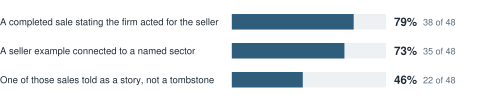
Thirty-eight of the 48 firms show at least one completed transaction that states, explicitly, that the firm acted for the seller — role language, not just a logo pair and a date. Thirty-five connect a seller-side example to one of the sectors they name, which is the join that makes a deal list searchable by relevance. But only 22 of 48 tell any of those transactions as a story: the situation the owner was in, what the process had to solve, what the outcome was for the seller. The dominant form remains the tombstone — and a tombstone, as every adviser knows and no deal page admits, is written for other dealmakers, not for the owner deciding whether these people understand her situation.
The missing story is the commercial cost. An owner reading a wall of tombstones learns that the firm closes; she does not learn what the firm did — whether it found the buyer nobody else would have called, held the price through a diligence scare, structured around a family complication. Those are the sentences that make a referral concrete, give the referral partner something to say beyond 'they're good', and give a retrieval system actual text to ground an answer in. A logo cannot be quoted.
Confidentiality is the honest and substantial objection, so it deserves an honest answer rather than a wave. Much of what happens inside a sale process cannot be published, and for some clients nothing can. But the constraint binds specific identifiers — names, prices, parties — not specificity itself. A narrated case need not name the company, the counterparty or the consideration: 'a family-held distributor in the Southeast, two competing strategics, a working-capital dispute resolved without repricing' discloses nothing privileged and says more than twenty tombstones. Twenty-two firms in this study have found a version of that line. The pattern is available to the whole market; the ten firms showing no explicit seller-side example at all are, in most cases, firms whose completed work simply is not stated as seller-side anywhere public — not firms without completed work.
What stronger evidence looks like
One case of about 150 words, anonymized, cleared once with the client, linked from the sector page it belongs to. It states the seller's situation, the problem the process had to solve, and the outcome in the seller's terms. Around it, a transaction list whose every entry states the firm's role — acted for the seller, acted for the buyer — so that even the tombstones answer the reader's first question.
Three actions for a quarter
- Write one 150-word seller case and clear it once — the legal review is a single conversation, not a program.
- State the firm's role on every existing transaction entry; it is one line per deal.
- Link the case from the named sector it belongs to, so depth and proof substantiate each other.
A logo proves a closing. A story explains a firm.
Basis: seller-representation example observed at 38 of 48 firms; sector-linked seller example at 35 of 48; narrated seller case at 22 of 48. All 48 firms had valid results on these items. The review cites firm-level transaction index pages only; no client, counterparty or individual transaction page is published. Evidence to August 31, 2026.
Signal six · Access
Reachable firms, unnamed hands
The last step of the pre-contact journey is the shortest and the most revealing: the reader has decided to reach out. Now the record answers one final question — to whom?
Everyone can be reached. Half can be reached by name.
Reachable — but by name?
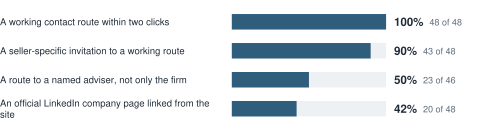
Access at the firm level is the sector's one perfect score: all 48 firms offer a working contact route within two clicks of the homepage, and 43 of 48 pair it with an invitation written for sellers specifically — a confidential conversation, a valuation discussion, language that tells an owner this door is for her. The mechanics of being contacted are solved.
The person is another matter. At the 46 firms where the question could be answered, exactly half offer a route to a named adviser — a professional email or an individual booking path — rather than only a firm-wide funnel. And the firm's presence on the platform where its counterparties spend professional attention is patchier than the sector likely assumes: 20 of 48 websites link an official, matching LinkedIn company page. The other 28 leave a reader to search the platform and guess among lookalikes — a small thing, until a retrieval system or a diligent CFO picks the wrong entity.
A firm-wide route is not a defect; for some firms it is intake discipline, and it works. The asymmetry this chapter points at is emotional, not operational. An owner deciding to make a first approach about the most consequential transaction of her life is not writing to a firm — she is deciding whether to approach a person. The record that ends at info@ asks her to start the relationship with a form. The record that ends with a named adviser, on the page where that adviser's expertise is described, lets the approach begin where trust actually forms: person to person. Half this market offers that; half doesn't. Few gaps in this study are cheaper to close.
The named route also does quiet work upstream, before any owner is involved. A referral partner introducing 'the firm' makes a corporate recommendation; introducing 'the partner who runs their industrials practice — here she is' makes a personal one, checkable in a click and easier to say out loud. Half the firms in this study give their referral network that sentence. The other half leave the introducer to improvise it.
What stronger evidence looks like
The advisers who take first calls are reachable by name, professionally — an email or a booking route on the biography itself, beside the expertise it describes. The seller invitation leads to a route someone actually monitors, and the firm's official LinkedIn page is linked from its own footer, so the entity a reader finds is the entity the firm controls.
Three actions for a quarter
- Give the two or three advisers who take first calls a named professional route, placed on their biographies.
- Send a test enquiry through the contact form and time the response; fix what the test reveals.
- Link the official LinkedIn company page from the site footer — one line of markup that removes a whole class of mistaken identity.
An owner doesn't approach a firm. She approaches a person — if the record offers one.
Basis: reachable contact route 48 of 48; seller-specific invitation 43 of 48; named-adviser route 23 of the 46 firms with a valid result (2 could not be verified); official LinkedIn company link 20 of 48. The review publishes no individual's contact details; the named-route finding is reported at firm level only. Evidence to August 31, 2026.
Chapter ten
What AI-mediated discovery changes — and what it does not
Somewhere between the referral and the call, one of the three readers of a firm's public record is now software. This chapter is about what that actually changes — which is both more and less than the industry selling 'AI visibility' would like it to be.
The convergence, which is the real story
Run the two demands side by side. The best-evidenced reason a human reader rules out a referred firm is that they could not understand how it could help them.[3] The published guidance of the one platform that documents how content is selected for AI-generated answers asks for content that stands on its own, names its entities clearly and consistently, keeps each page to a single topic, and puts key information early.[13] Those are two unrelated bodies of evidence — a 2015 survey of professional-services buyers and a search platform's technical documentation — arriving at the same instruction: say what you do, plainly, early, and in text. The convergence claim itself is this report's argument, not a measured finding; no study tests whether one intervention serves both readers. But it is why this report has no separate 'AI strategy' chapter. The six signals are the AI strategy.
The properties that make a firm easy to understand are the properties that make it easy to retrieve.
What the platforms actually say
Underneath the noise, the operators' own documentation is specific, and most of it is about eligibility rather than advantage. Google states that appearing in its generative AI features requires a page to be indexed and eligible to appear in search with a snippet — there is no separate AI index to join.[14] OpenAI states that eligibility for inclusion requires allowing its search crawler and confirming that the site's host or CDN accepts traffic from its published addresses — so a permissive robots file with an aggressive firewall rule yields nothing.[15] The operators separate search crawlers from training crawlers, and blocking one is not blocking the other. And since August 31, 2026, a site-level control in Google's Search Console can exclude a site from Google's AI features while leaving ordinary search untouched — a setting that is inherited from a parent web property by default, and whose effect produces no symptom in conventional search reporting. A firm can be absent from AI answers because of a checkbox nobody remembers, on a property nobody looks at.[16] These are configuration facts, checkable in an afternoon, and they are prerequisites — the difference between eligible and ineligible, not a promised improvement.
What the measurements actually show
Three findings set honest expectations. First, AI answer systems are non-deterministic: in the one systematic study we identified, identical prompts re-run the same day produced cited-source overlap of roughly a third to two-fifths across four major engines — and that study was run on Swiss consumer categories, so its magnitudes are not M&A figures; the instability is the transferable part.[17] Second, it follows that asking an assistant once who the best advisers are produces almost no information: presence in these systems is a distribution over repeated runs, not a position, which is why this report measured none of it at firm level and treats every one-shot 'AI ranking' as theater. Third, being cited is not being represented: in 1,600 controlled tests across eight AI search engines, researchers found source-attribution error rates between 37 and 94 percent by engine.[19] Meanwhile the ground is moving under the traffic reports — in a large US metered-browsing study from March 2025, users clicked a conventional result in 8 percent of visits when an AI summary appeared, against 15 percent when none did.[20] Fewer verification journeys now touch the firm's own analytics, which means a firm can be being read, summarized and shortlisted — or misdescribed — with no trace in its referral numbers.
What does not change
No evidence anywhere in this review or the literature behind it establishes that completing any checklist produces inclusion in AI answers to competitive adviser-selection queries, and the concentration of AI citations toward large, established sources suggests modest expectations for any single firm. This report therefore recommends nothing that is only worth doing if it moves an AI metric. The work it does recommend — plain statements of who the firm serves, one topic per page, named and dated authorship, transaction evidence written as text rather than locked in imagery, an unambiguous entity with a linked official profile — is worth doing for the human readers who are better evidenced anyway. That the same work is what the machine layer's own operators ask for is the reason to do it once, properly, rather than twice under two labels.
What this review could and could not see
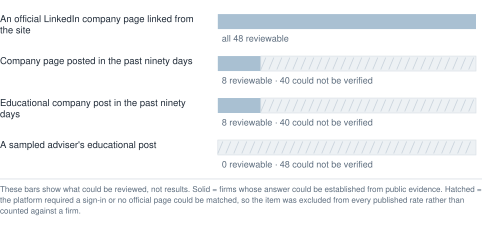
One honest exhibit belongs here, because it demonstrates on this study's own data how uneven the machine-readable surface already is. The review attempted four questions about each firm's LinkedIn presence. The first — does the website link an official, matching company page? — could be answered for all 48 firms. The other three could mostly not be answered at all, because the platform requires a sign-in before recent posts can be inspected, and the review does not sign in, impersonate or scrape. Those walls fall identically on every firm, so the items were excluded from every published rate rather than counted against anyone. But note what the walls mean: activity conducted inside a gated platform is visible there and largely invisible everywhere else. A firm whose only current public voice lives behind a sign-in has currency a stranger's tools may never see.
What the review could and could not see on LinkedIn
Three questions for anyone selling you AI visibility
The gap between what platforms document and what the optimization industry sells is wide enough that a filter is genuinely useful. First: which of your recommendations does any platform's own documentation say it uses?[14] Google states publicly that it does not consume special AI files, that no AI-specific markup or restructuring is required, and that no third-party tool has access to its internal systems — so a proposal built on those things starts owing you an explanation. Second: how many runs, over how many days, sit behind any 'ranking' you are shown? Given measured run-to-run instability, a screenshot of one answer is not a measurement. Third: what would this engagement change on our own pages that a human reader would also value? If the honest answer is nothing, the work fails the only test this report's evidence supports.
Platform statements: Google and Microsoft webmaster and AI-features documentation and OpenAI crawler documentation as re-verified October 5, 2026 (two source documents are undated; see Notes and sources). Non-determinism, citation-error and click-behavior studies: see Notes and sources for samples, dates, verticals and limitations. LinkedIn coverage: valid results for 48, 8, 8 and 0 of 48 firms respectively across the four questions.
Chapter eleven
What a strong public record looks like
This report has named six signals and shown where each thins. Assembled the other way around, the same findings describe something more useful: what the public record of a well-evidenced M&A advisory firm actually contains. Nothing below is hypothetical — every element was observed, working, somewhere in this study. No single firm has all of them, which is its own finding.
The opportunity is not to publish more. It is to make existing expertise easier to verify.
A homepage that lets a reader self-qualify
It says the firm advises owners on selling businesses, names the owners it serves, and states a size range in the reader's own vocabulary. Three sentences do the work. The reader who fits knows it in ten seconds; the reader who doesn't is saved a call neither side wanted — and the referral partner forwarding the link knows exactly what their introduction is walking into.
A sector page a generalist could not have written
One named industry, two or three things true of it alone: who competes to buy these assets, what diligence keeps finding, where value concentrates. Four hundred words, dated, linked from the sector list that makes the claim. It reads like the first ten minutes of a pitch meeting — which is exactly the meeting it is auditioning for.
A biography that leads somewhere
Role, background, transactions — and then the chain: two or three dated items the adviser personally wrote or presented, on pages the firm controls, with a professional route to that person beside them. It is the difference between asserting judgment and exhibiting it, and in this sample it would currently be unique.
A deal list that answers the seller's question
Every entry states the firm's role. At least one transaction is told as a 150-word story — situation, problem, outcome — anonymized, cleared once, linked from its sector. The tombstones prove the firm closes; the story explains what the firm is like to be represented by.
A visible pulse
Four dated items a year, spread across it, each answering a question owners ask. A signup for the next one. Dates on everything, so currency is checkable rather than asserted.
An unambiguous identity
One entity name used consistently, an about page that states plainly what the firm is and where it operates, and the official profiles linked from the site itself — so that a human, a database or a language model resolving 'the advisory firm by that name' lands on the firm's own record and not a lookalike's.
None of this is a guarantee of anything, and this report will not pretend otherwise. What each element does is narrower: it makes verification cheap. The evidence assembled here says the verifying is already happening — the only question a firm controls is whether its record answers.
Three ways firms get this wrong
The failure modes are as observable as the successes, and three recur. The first is volume as a substitute for specificity: a firm concludes it needs 'content', commissions twelve interchangeable posts, and ends the year more generic than it started — when one sector page a competitor could not have written would have done more. The second is gating the evidence: the whitepaper that would demonstrate depth sits behind a form, invisible to the referred owner who will not trade her email for it and to every retrieval system that cannot fill in forms. Whether gating costs more than the addresses it captures has never been measured, but a gated proof is not proof to a verifier. The third is outsourcing the voice: material written far from the deal team reads that way, and the reader this report has followed for eleven chapters — skeptical, time-poor, fluent — is precisely the reader who can tell. The fix for all three is the same discipline: publish less, publish specifically, and keep the advisers' fingerprints on it.
Each element above corresponds to one or more of the 27 reviewed questions; observed prevalence for every underlying item appears in chapters four through nine.
Chapter twelve
A 30/60/90-day agenda
Everything in this chapter comes from the findings and nothing else. It is sequenced by cost and reversibility — cheapest and most easily undone first — not by any measured effect, because no such measurement exists. A marketing lead can run the whole agenda without a consultant; most items are partner-hours, not budget.
The agenda at a glance
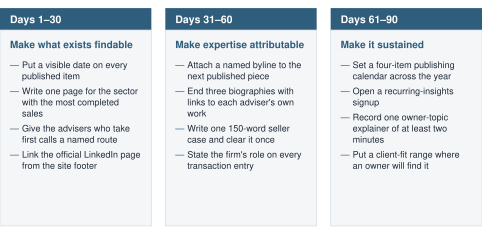
Days 1–30 — make what exists findable
Nothing new is written this month. Dates go on every already-published item. The sector with the most completed sales gets its page drafted from an hour with the adviser who closed there most recently. The two or three advisers who take first calls get named routes on their biographies. The official LinkedIn page gets linked from the footer. A test enquiry goes through the contact form, and someone times the answer.
Days 31–60 — make expertise attributable
The next published piece carries a named byline, and so does everything after it. Three biographies gain a short list of that adviser's own work. One seller case gets written in 150 words — situation, problem, outcome — cleared once with the client, and linked from its sector page. Every entry on the transaction list gains one line stating the firm's role.
Days 61–90 — make it sustained
A four-item calendar is set for the coming year, one item per quarter, each answering a question owners actually ask. A recurring-insights signup opens and routes to a monitored inbox. If one adviser is willing, one owner-topic explainer of at least two minutes gets recorded and dated, with their name on the page. The client-fit range is published where a first-time reader will meet it — the one item this agenda saves for last only because it may need a partners' conversation first.
What this agenda deliberately leaves out
No paid campaigns, no redesign, no rebrand, no new platform, no AI-visibility subscription. Not because those are never worth doing, but because nothing in this study's evidence requires them, and each is a way to spend real money before the free work is done. The findings say the sector's problem is rarely reach and almost never aesthetics — every firm here is findable and most look the part. The problem is that the record runs out of evidence exactly where a verifier starts looking for it. Ninety days of partner-hours addresses that directly. What the agenda also leaves out is any promise about results: these steps make a firm easier to verify, which the evidence supports, not more likely to win any given mandate, which nothing measured here could support.
The 27 questions, as a self-assessment
These are the questions this study asked of every firm, in plain English, grouped by signal. Read them against your own public record — ideally in a private browser window, as a stranger would. There is no score and no passing grade; the useful output is the two or three questions whose honest answer surprises you.
Clarity
- Does the homepage say the firm advises owners on selling a business?
- Does the homepage name the owners it is written for?
- Is there a published size range for the clients the firm works with?
- Is there a dedicated page about selling a business?
Depth
- Are the sectors the firm serves named on the public site?
- Is there a dedicated page for a named sector, with sector-specific substance?
Authority
- Do the adviser biographies we sampled set out a current role and background?
- Has a named current adviser authored or presented educational material in the past year?
- Does an adviser biography link to that adviser's own published material?
- Does a dated educational video from the past year feature a named current adviser?
Currency
- Is there a public collection of owner-facing material in one place?
- Is there substantive owner-education material publicly available?
- Was owner-education material published in the past twelve months?
- Was owner-education material published in the past ninety days?
- Is publishing sustained across the year rather than concentrated?
- Is there a public signup for recurring insights?
- Is there an owner-topic educational video of at least two minutes?
Proof
- Is there a completed transaction example that states the firm acted for the seller?
- Is one seller example told as a narrative rather than a logo or a tombstone?
- Is a seller example connected to one of the firm's named sectors?
Access
- Is a working contact route reachable within two clicks of the homepage?
- Is there a seller-specific invitation leading to a working contact route?
- Is there a named-adviser contact route, rather than only a firm-wide one?
- Does the website link an official, matching LinkedIn company page?
Three more, best checked from inside the firm
- Has the official company page posted in the past ninety days?
- Has the official company page published an educational post in the past ninety days?
- Has a sampled adviser published an educational post in the past ninety days?
Identical wording to the questions used in the review and in the advance factual-review packets sent to every named firm.
Part Two
Part Two
The 48 firms
Everything in Part One is sector-level. The firm-level record — all of it — is public too, and it follows here: one profile for each of the 48 firms, alphabetically and in no other order.
Every profile answers the same 27 questions under the same framework. The first page of each profile is the readable snapshot: what the firm's public record shows, its publicly demonstrated strengths, its clearest opportunities to make existing expertise easier to verify, the six signals in brief, and where a marketing lead could start. The second part is the complete evidence record: all 27 questions with the result of the review and the public sources that were examined. Where a firm submitted a factual correction during the review window and the evidence supported it, the record was corrected before publication; where a firm chose to add an attributed comment, it is published with its profile. The profiles say nothing about whether a firm responded, and draw no conclusion from silence.
Three things these profiles deliberately are not. They are not a ranking: no score, no grade, no composite, no ordering except the alphabet, and no visual that plots one firm against another. They are not personnel files: no individual is named anywhere in them, and sources cite firm-controlled pages only. And they are not verdicts on any firm's capability: a profile records what a stranger could verify from public evidence in a defined window, which Part One has argued is exactly, and only, what a public record is.
If you lead one of these firms: read your own profile first — LeadNBFI sent every firm its complete draft record in advance of publication. Then read two competitors' profiles the way a referred owner would read yours, side by side, asking which record would survive the comparison. That exercise, more than any chapter in Part One, is the argument.
Factual corrections to any profile: corrections@leadnbfi.com. Qualifying corrections are reviewed against the same criteria applied to every firm and applied to the public record.
- 1858 Capital Partners1858partners.com
- Apex Exit Advisors, LLCapexexit.com
- ASA Ventures Groupasaventuresgroup.com
- Auctus Capital Partnersauctuscapitalinc.com
- Berman Capitalbermancap.com
- BMI Mergers & Acquisitionsbmimergers.com
- Bravaldo Capital Advisorsbravaldocapitaladvisors.com
- Business Transition Strategiesbusinesstransitionstrategies.com
- Calabasas Capitalcalabasascapital.com
- Chaffe & Associates, Inc.chaffe-associates.com
- Commonwealth M&Acommonwealthmna.com
- Cornerstone Business Services, Inc.cornerstone-business.com
- Dickinson Williams & Companydickinsonwilliams.com
- EdgePoint Capital Advisorsedgepoint.com
- Evangeline Securitiesevangelinesecurities.com
- Excendio Advisorsexcendio.com
- Flatirons Capital Advisorsflatironscap.com
- Goldmark Advisers, Inc.goldmarkadvisers.com
- Grand Avenue Capital Partnersgrandavenuecapital.com
- Graymarc Business Advisorsgraymarc.com
- Great Plains Capital Partners, LLCgreatplainscp.com
- Green Circle Capital Partners LLCgreencirclecap.com
- Harbor Ridge Capitalharborridgecap.com
- Idea Tree Advisoryideatreeadvisory.com
- Krea Business Advisory Services Inc.kreabusiness.com
- Lawrence, Evans & Co., LLClawrenceevans.com
- Madfarm Advisorsmadfarm-advisors.com
- Masswell Capitalmasswellcapital.com
- MergersCorp M&A Internationalmergerscorp.com
- Metro Business Advisorsmetrobusinessadvisors.com
- MidCap Advisorsmidcapadvisors.com
- Navantnavantpartners.com
- Neri Capital Partnersnericap.com
- Paine Pacific, LLCpainepacific.com
- Peregrine Advisorsperegrine-advisors.com
- Raincatcherraincatcher.com
- Roadmap Advisorsroadmapadvisors.com
- Stevenson & Companystevensonco.com
- Strategic M&A Advisors, LLCstrategicmaadvisors.com
- Taureau Grouptaureaugroup.com
- The Inman Companyinmanco.com
- Topsail Capital Advisorstopsailcapitaladvisors.com
- Tounge Associatestoungeassociates.com
- Trailhead Partnerstrailhead-partners.com
- Trinity Transaction Advisorytrinitytransactions.com
- Vesticor Advisorsvesticor.com
- Westlake Securitieswestlakesecurities.com
- Young America Capital, LLCyacapital.com
Part Three
Part Three
How to read the research
LeadNBFI reviewed publicly accessible material associated with 48 US M&A advisory firms against 27 predefined indicators. Evidence was limited to material available by August 31, 2026. Where a conclusion could not be verified, it was excluded from the relevant rate. Before publication, LeadNBFI sent every named firm its draft record and invited it to identify factual errors and provide qualifying public evidence.
The sample
This report describes a locked sample of 48 US M&A advisory firms, identified through a public directory listing frame — the public M&A adviser directory published by Axial, a private-deal network with which LeadNBFI has no affiliation; the frame supplied firm identities only, and nothing from it enters any finding — and screened against published eligibility rules. It is not a probability sample, not a census of the sector, and not a representative survey of US M&A advisory firms. Its findings describe what a defined public-evidence review located for these 48 firms, against 27 published indicators, on or before August 31, 2026. They do not describe the sector as a whole, and they do not describe any firm's quality, competence, conduct, regulatory standing, client outcomes or commercial performance.
The questions and the windows
The 27 questions were defined and locked before any firm was reviewed, and identical wording was applied to every firm; the full set appears in chapter twelve. Time-bound questions use two windows ending at the cutoff: the year from September 1, 2025 to August 31, 2026, and the ninety days from June 3 to August 31, 2026. Undated material cannot establish that something is recent, which is one reason visible dates recur in this report's recommendations.
How a gap is counted
Each firm-question pair produced one of three outcomes: observed in the reviewed public evidence; not observed in the reviewed public evidence as of August 31, 2026; or could not be verified — because a platform restricted access, or an inspection could not be completed. Every published rate divides observed by observed-plus-not-observed. Items that could not be verified are excluded from the rate and reported separately, never counted against a firm. Of 1,296 observations across the study, 1,144 produced a valid answer and 152 were excluded; for a typical firm, 24 of the 27 questions could be answered. Public websites were reviewed as a visitor would see them: no sign-ins, no form submissions, no paywall circumvention.
Four limitations that matter
- The sample is defined, not representative. Nothing here generalizes beyond the 48 firms reviewed, and no headline in this report should be read as a statement about the US M&A advisory market as a whole.
- Visibility is not capability. The review reads public evidence only. It cannot see, and does not claim to see, the quality of any firm's advice, relationships or outcomes.
- Regulatory posture is not modeled. US M&A advisory firms operate under materially different regimes — FINRA membership, SEC investment-adviser registration, or the federal M&A broker exemption — and some differences in what firms publish may reflect compliance judgment rather than marketing choice. This review did not code firms' regulatory status and draws no firm-level conclusion from content-volume differences.
- Some surfaces resist inspection. Three LinkedIn-activity questions could not be verified for most firms because the platform requires a sign-in; the items are excluded from every rate and reported as a limitation, identically for all firms.
The wider evidence
Where this report cites research beyond the 48-firm review — on referrals, professional-services buying, platform behavior or AI systems — each claim was independently verified against its primary source, and the population, date and any publisher interest are stated at the point of use or in the Notes and sources. One boundary claim is worth stating in full: as at October 5, 2026, we identified no published, methodologically transparent study that measures how owners of US lower-middle-market companies discover, research or select M&A advisers by channel, and none that measures AI-assisted discovery of M&A advisers.[1, 12] The closest AI evidence is an independent study, not yet peer-reviewed, of which financial advisory firms, doctors and care facilities AI assistants recommend in the 100 largest US metropolitan areas; it measures the recommendations, not how anyone used them, and does not cover M&A advisers.[18] Every behavioral figure in this report is therefore transferred from adjacent markets, and is labeled as such where it appears.
Questions this research cannot answer
Three, and they are the three a reader most wants answered. Whether stronger public evidence causes firms to win more or better mandates: no observational study can establish that, including this one, because firms that win more have more to publish and more to spend — the association runs both ways by construction. Which signal matters most: we identified no source that measures the relative weight owners place on any of them, and this report deliberately never says one signal outranks another. And how owners of US lower-middle-market companies actually behave when choosing an M&A adviser: the boundary statement below stands, and until someone funds that study, every behavioral number in this field — including the ones quoted here — is a transfer from an adjacent market. A report that pretended otherwise would be easier to sell and harder to trust.
Corrections and the fuller record
Before publication, LeadNBFI sent each of the 48 named firms its draft record. Firms were invited to submit factual corrections, qualifying public evidence or an optional attributed comment by September 28, 2026 at 5:00 PM ET; any correction accepted on the evidence was applied before publication. Factual corrections remain welcome after publication at corrections@leadnbfi.com and will be reviewed against the same criteria applied to every firm. The sample, the windows, how each result is counted and the limitations are set out above; all 27 questions appear in chapter twelve; and every firm's complete record, each result with the public sources reviewed, appears in Part Two.
Literature search of September 18, 2026 (OpenAlex, Crossref, Semantic Scholar, arXiv and open web search), updated October 5, 2026 (OpenAlex, Crossref, arXiv and open web search; Semantic Scholar was not re-queried); not covered: Web of Science, Scopus, EBSCO Business Source, ProQuest. Vendor-authored, self-deposited reports were excluded. Closest identified study: a 2023 survey of 130 completed lower-middle-market sellers (Marks, Howard and Stevenson), full text not obtained. A negative claim about a literature is true as of its search date, and this one is dated accordingly.
Part Three · Reference
Notes, Sources and References
LeadNBFI benchmark sources
- [1] LeadNBFI. Literature search on M&A adviser discovery and selection. LeadNBFI research records, September 18, 2026; updated October 5, 2026. Systems searched: OpenAlex, Crossref, Semantic Scholar, arXiv and open web search (Semantic Scholar not re-queried on October 5); not covered: Web of Science, Scopus, EBSCO Business Source, ProQuest; vendor-authored, self-deposited reports excluded.Use in this report: A negative claim about a literature is true as of its search date and is dated accordingly; the closest identified study is Marks, Howard and Stevenson (2023), whose full text was not obtained; the closest AI evidence is Ibrahim and Zaki (2026), which does not cover M&A advisers.
- [2] LeadNBFI. The LeadNBFI M&A Advisor Visibility Benchmark 2026. LeadNBFI (this report), Evidence to August 31, 2026; published October 5, 2026. 48 US M&A advisory firms; 27 predefined questions per firm; 1,296 observations, of which 1,144 produced a valid result and 152 could not be verified; corrected observation totals 694 observed and 450 not observed.Use in this report: A defined sample, not a census or probability sample; findings describe public visibility, never firm capability. Rates divide observed by observed-plus-not-observed; unverifiable items are excluded, never counted against a firm.
Referral and professional-services research
- [3] Hinge Research Institute. Referral Marketing for Professional Services Firms. Hinge Research Institute, 2015. Online survey of 523 professional-services firms; multi-select items. https://hingemarketing.com/uploads/hinge-research-referral-marketing.pdf (verified October 5, 2026).Use in this report: The publisher sells marketing programs to professional-services firms; respondents describe purchases for their own firms, not owners selecting a sell-side adviser. Figures are stated behavior, not observed behavior.
- [4] Exit Planning Exchange (XPX) and Hinge Research Institute. Referral Marketing Study. Exit Planning Exchange, Undated document; earliest verifiable posting May 2025. Survey of 262 advisers in the private-company transition community, of whom 13.4% were M&A intermediaries. https://www.exitplanningexchange.com/wp-content/uploads/2025/05/HINGE-XPX-Report-on-Referrals-Research.pdf (verified October 5, 2026).Use in this report: Same publisher as the 2015 study above; respondents are referral sources reporting stated, not observed, behavior. The study's own net-benefit analysis treats website quality as a threshold factor, and neither half of that analysis should be quoted without the other.
M&A adviser-selection and reputation research
- [5] Darby, Michael R., and Edi Karni. Free Competition and the Optimal Amount of Fraud. Journal of Law and Economics, 16(1), 67–88, 1973. https://doi.org/10.1086/466756 (verified October 5, 2026).Use in this report: Economic theory; the application of the credence-good framing to M&A advisory is this report's inference, used as an explanatory lens, not a finding.
- [6] Rau, P. Raghavendra. Investment bank market share, contingent fee payments, and the performance of acquiring firms. Journal of Financial Economics, 56(2), 293–324, 2000. Deal-database study of US acquisitions. https://doi.org/10.1016/S0304-405X(00)00042-8 (verified October 5, 2026).Use in this report: Acquirer-side, predominantly public-company sample; reputation operationalized as market share. Measures nothing about websites, digital visibility or sell-side owner selection.
- [7] Sibilkov, Valeriy, and John J. McConnell. Prior Client Performance and the Choice of Investment Bank Advisors in Corporate Acquisitions. Review of Financial Studies, 27(8), 2474–2503, 2014. Deal-database study of acquirer adviser choice. https://doi.org/10.1093/rfs/hhu031 (verified October 5, 2026).Use in this report: Acquirer-side; finds, contrary to earlier studies, that prior client performance predicts adviser choice. No digital variable.
- [8] Golubov, Andrey, Dimitris Petmezas, and Nickolaos G. Travlos. When It Pays to Pay Your Investment Banker: New Evidence on the Role of Financial Advisors in M&As. Journal of Finance, 67(1), 271–311, 2012. Deal-database study of public acquisitions. https://doi.org/10.1111/j.1540-6261.2011.01712.x (verified October 5, 2026).Use in this report: Acquirer-side, public acquisitions; top-tier advisers measured by league-table standing. No digital variable.
- [9] Alexandridis, George, Nikolaos Antypas, and Vicky Lee. Do boutique investment banks have the Midas touch? Evidence from M&As. European Financial Management, 30(1), 634–672, 2023. Deal-database study of acquirer-side outcomes. https://doi.org/10.1111/eufm.12425 (verified October 5, 2026).Use in this report: Buy-side performance study; effects concentrate where valuation uncertainty is highest. No digital variable.
- [10] Chang, Xin, Chander Shekhar, Lewis H. K. Tam, and Jiaquan Yao. Industry Expertise, Information Leakage and the Choice of M&A Advisors. Journal of Business Finance & Accounting, 2015. Deal-database study of firms' adviser choice. https://doi.org/10.1111/jbfa.12165 (verified October 5, 2026).Use in this report: Acquirer/firm-side deal-database study: industry expertise increases the likelihood an adviser is chosen and is associated with higher fees and completion likelihood. Never cited here as evidence about channels or websites.
Owner-transition and lower-middle-market research
- [11] McDonald, Michael B., IV. The Value of Middle Market Investment Bankers. Fairfield University / Michael McDonald (study suggested by Carter Morse & Mathias), 2016. Survey of 85 US owners who sold owner-operated companies of $10m–$250m during 2011–2016, recruited through 25 participating banks' completed deals. https://www.exitstrategiesgroup.com/wp-content/uploads/2017/03/The_Value_of_Middle_Market_Investment_Bankers.pdf (verified October 5, 2026).Use in this report: Stated drivers of bank choice: reputation 24.2%, industry expertise 21%, track record 16.1%; the largest single category is unspecified 'other' at 38.7%. Completed deals only; the study does not establish where owners formed these impressions.
- [12] Marks, Kenneth H., John A. Howard, and Anthony Stevenson. Private Company Seller Perspectives in Lower-Middle Market M&A. Advances in Mergers and Acquisitions (Emerald), pp. 67–75, 2023. 130 questionnaire responses from individuals who completed a private-company sale in the lower middle market, 2013–2022. https://doi.org/10.1108/S1479-361X20230000022005 (verified October 5, 2026).Use in this report: Closed access; the full text was not obtained. Two of three authors are principals of a US M&A advisory firm; geographic scope is not stated in the abstract, and it is not established that the study measures the discovery or selection channel. Cited only as the closest identified study.
Search, AI-discovery and platform documentation
- [13] Microsoft Bing. Bing Webmaster Guidelines. Microsoft, Undated. https://www.bing.com/webmasters/help/webmaster-guidelines-30fba23a (verified October 5, 2026).Use in this report: Operator documentation states policy and intent, not measured effect; the page is undated and subject to change. Source of the entity-clarity and grounding guidance and of the statement that generative optimization does not guarantee grounding or citations.
- [14] Google Search Central. Optimizing your website for generative AI features on Google Search. Google, Last updated July 10, 2026. https://developers.google.com/search/docs/fundamentals/ai-optimization-guide (verified October 5, 2026).Use in this report: Operator documentation; states eligibility requirements and that no AI-specific files, markup or restructuring are required. Not evidence of commercial outcomes.
- [15] OpenAI. OpenAI crawler documentation, with the OpenAI Help Center article 'Searching the web with ChatGPT'. OpenAI, Undated / relative-dated pages. https://developers.openai.com/api/docs/bots (verified October 5, 2026).Use in this report: Operator documentation; separates search crawling from training crawling and states eligibility conditions. Actively rewritten pages; reverified October 5, 2026.
- [16] Google Search Console Help. Search generative AI control. Google, Undated page; worldwide rollout noted as complete on August 31, 2026. https://support.google.com/webmasters/answer/16908024 (verified October 5, 2026).Use in this report: Operator documentation for the site-level control; the control and the related performance report are two distinct features. States the setting is not used as a ranking signal elsewhere in Search.
- [17] Schulte, Julius, Malte Bleeker, and Philipp Kaufmann. Don't Measure Once: Measuring Visibility in AI Search (GEO). University of St. Gallen; arXiv:2604.07585 (preprint), April 2026. 8 prompts × 4 Swiss consumer verticals × 4 engines; 45–46-day series with same-day re-runs. https://arxiv.org/abs/2604.07585 (verified October 5, 2026).Use in this report: Not peer-reviewed; one author is affiliated with a commercial monitoring vendor (disclosed in the paper); the authors warn results may not generalize beyond the measured markets. Used only for the existence and rough scale of run-to-run instability.
- [18] Ibrahim, Hazem, and Yasir Zaki. Understanding AI Provider Recommendations in Local Service Markets. New York University Abu Dhabi; arXiv:2609.18341 (preprint), September 16, 2026. AI-assistant recommendations for financial advisory firms, primary-care doctors, hospitals, nursing homes and restaurants in the 100 largest US metropolitan areas, matched against official registries (for advisory firms, SEC investment-adviser records); open-weight and proprietary models, with and without web search. https://arxiv.org/abs/2609.18341 (verified October 5, 2026).Use in this report: Not peer-reviewed. Measures what AI assistants recommend, not how anyone used the recommendations; covers SEC-registered financial advisory firms, not M&A advisers. Cited only as the closest AI evidence to the boundary claim, found in the October 5, 2026 search update.
- [19] Jaźwińska, Klaudia, and Aisvarya Chandrasekar. AI Search Has a Citation Problem. Tow Center for Digital Journalism, Columbia Journalism Review, March 6, 2025. 1,600 controlled queries: 20 publishers × 10 articles × 8 AI search engines. https://www.cjr.org/tow_center/we-compared-eight-ai-search-engines-theyre-all-bad-at-citing-news.php (verified October 5, 2026).Use in this report: News publishers, not advisory firms; findings represent one run per query of dynamic systems (the authors' own stated limitation).
- [20] Pew Research Center. Google users are less likely to click on links when an AI summary appears in the results. Pew Research Center, July 22, 2025. Metered browsing of 900 US adults; 68,879 Google searches during March 2025. https://www.pewresearch.org/short-reads/2025/07/22/google-users-are-less-likely-to-click-on-links-when-an-ai-summary-appears-in-the-results/ (verified October 5, 2026).Use in this report: US general-population consumer behavior in a single month; not B2B, not advisory, and not a causal design.
Firm-profile public sources
Each of the 48 firm profiles in Part Two carries its own record of reviewed public sources — the firm-controlled pages the review actually inspected for that firm. Those firm-level source lists are part of this report's public record and are preserved, firm by firm and question by question, in the publication's structured data. They are not repeated here. Where a reviewed page no longer resolved at the final link check on October 5, 2026, its link was removed rather than replaced with a page the review did not inspect; the result recorded at the August 31, 2026 evidence cutoff is unchanged, and a result left without a page of its own cites the firm's website. Open the firm directory.
Part Three
About LeadNBFI
LeadNBFI is a specialist financial services marketing agency built for firms that sell trust: hedge funds, venture capital firms, investment banks and M&A advisers in the US. The firm's work spans positioning and messaging, search and AI-search visibility, content and thought-leadership programs, LinkedIn strategy, video and corporate branding — built with compliance review in mind, for markets where credibility precedes conversation.
This report is LeadNBFI research. The benchmark was designed and executed to publication rules stated in Part Three, every named firm was sent its draft record before release, and the research team's findings were not adjusted for commercial convenience — several pages of this report argue against things marketing agencies routinely sell. That is deliberate. The firm's interest is a market that takes public evidence seriously; the report earns that interest honestly or not at all.