
Introduction
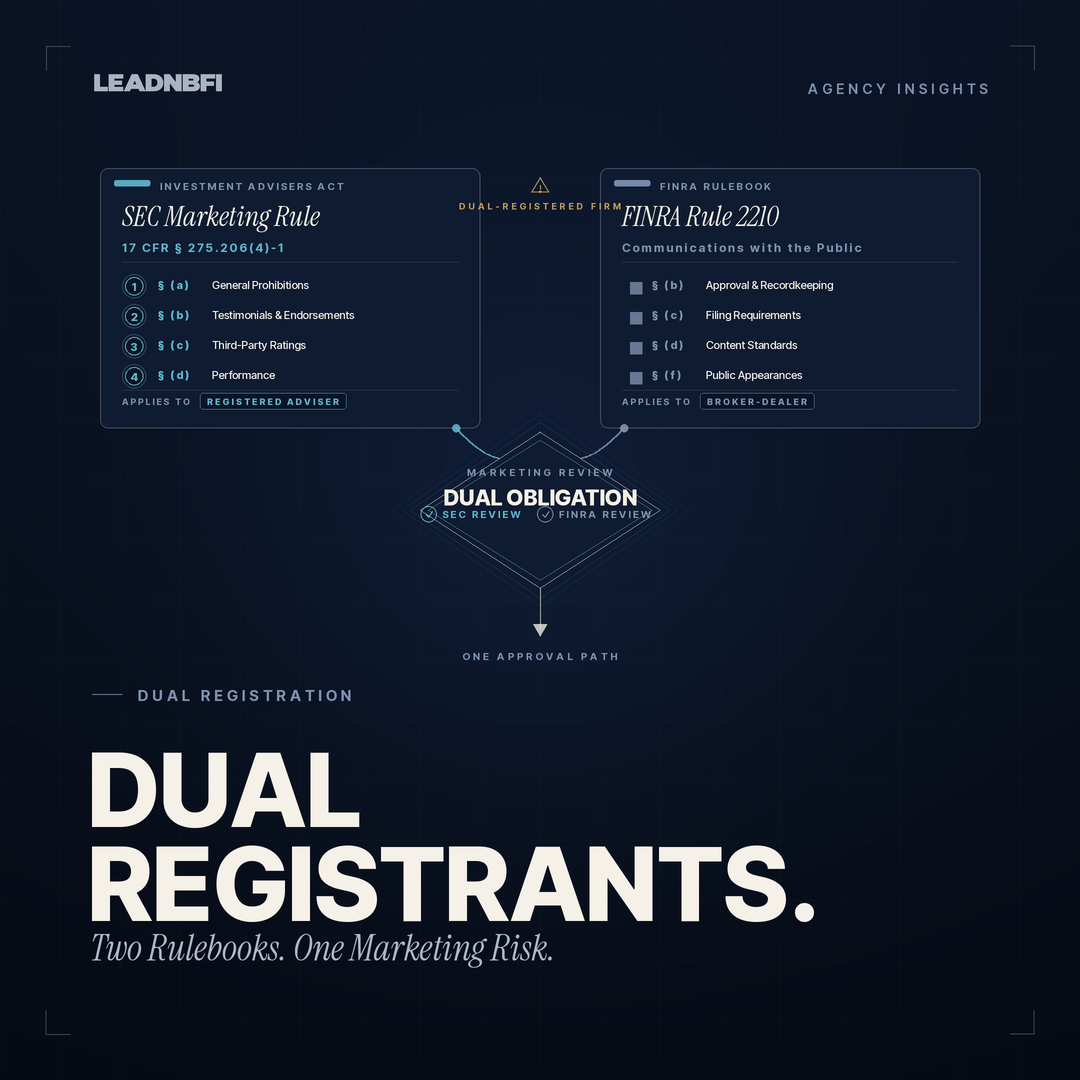
If your firm is registered as both an SEC investment adviser and a FINRA broker-dealer, your marketing sits under two rulebooks at once. The question is not simply which rule you prefer. The question is which rule applies to the communication, the audience, the channel, and the capacity in which the firm is speaking.
That distinction matters for websites, pitch decks, LinkedIn posts, performance materials, testimonials, private fund materials, and any public-facing content that describes the firm's securities business.
This article is for general information only and is not legal advice. Dual-registrant marketing compliance is fact-specific, and one of the rules discussed below is subject to a pending amendment. Confirm any decision with your compliance principal or outside counsel before publishing.
The dangerous assumption: one clearance covers both
A firm registered as both an SEC investment adviser and a FINRA-member broker-dealer often runs marketing through one compliance process and assumes the job is done.
The RIA side clears a piece under the SEC Marketing Rule and publishes it. Or the broker-dealer side runs the material through principal approval under FINRA Rule 2210 and publishes it. Either way, the firm assumes it has cleared the relevant gate.
That assumption is dangerous because neither regime preempts the other. Neither regulator has said that compliance with one rule automatically satisfies the other. When a communication falls within both rules, the firm has to satisfy both at the same time.
There is no clean marketing-only capacity test that solves this problem. Regulators built an explicit capacity framework for Regulation Best Interest and Form CRS, where a firm must disclose whether it is acting as a broker-dealer or an adviser. They did not build an equivalent shortcut for marketing content.
The practical result: much dual-registrant marketing is governed by both rules at once, and the firm has to design the content to survive the stricter requirement wherever the two regimes differ.
Which rule actually applies?
The scope of each rule, not the firm's preferred label, determines what governs a communication.
The SEC Marketing Rule applies to adviser advertisements, including communications that offer the adviser's advisory services with regard to securities, subject to the rule's definitions, exclusions, and conditions.
FINRA Rule 2210 applies to communications by a FINRA-member broker-dealer with the public, categorized as retail communications, correspondence, or institutional communications depending on audience and distribution.
A typical dual-registrant communication can fall into one of three buckets.
A purely brokerage communication — for example, a transactional brokerage fact sheet with no advisory offer — is governed by FINRA 2210 and related broker-dealer rules, but generally not by the SEC Marketing Rule because it does not offer advisory services.
A purely advisory communication, made only in the adviser's capacity through an RIA-only brand where the broker-dealer is not holding itself out, may be governed by the SEC Marketing Rule but may fall outside FINRA Rule 2210 if the FINRA member is not the one distributing it.
Most dual-registrant marketing — the combined website, the public pitch deck, the LinkedIn presence, or a service page describing both advisory and brokerage capabilities — can be subject to both regimes at once. A page that promotes an advisory strategy and is distributed by a FINRA member to the public can be both a Marketing Rule advertisement and a Rule 2210 communication.
That overlap is not an edge case. It is the normal risk zone.
For firms building public content, this is also a website architecture issue. A combined broker-dealer/RIA website needs clear capacity language, clean service segmentation, and review workflows that reflect how the content will actually be used. That is where financial services content marketing and compliance review have to be designed together, not bolted together at the end.
Collision point one: performance and projections
Performance content is the sharpest conflict.
The SEC Marketing Rule permits certain hypothetical performance, including model, backtested, projected, and targeted performance, but only subject to conditions. Those conditions include policies and procedures designed to ensure the performance is relevant to the likely financial situation and investment objectives of the intended audience, along with required information and disclosures.
FINRA Rule 2210(d)(1)(F), by contrast, generally prohibits broker-dealer communications from predicting or projecting performance, implying that past performance will recur, or making exaggerated or unwarranted claims, opinions, or forecasts, subject to limited exceptions.
That means the same sponsor may be able to use a projection in an adviser-only communication while being unable to use that same projection in a broker-dealer communication.
For a single dual-use retail brochure intended to run through both channels, the FINRA prohibition effectively governs. The firm cannot include a projection that violates Rule 2210 simply because the adviser regime might allow it under conditions.
In practice, dual registrants usually manage this gap through segmentation. Hypothetical or targeted performance may be confined to RIA-only materials, private fund pitch books, institutional decks, or gated advisory portals. It should not be casually reused in broker-dealer retail communications without confirming that the broker-dealer rule permits it.
One moving piece to track: FINRA has been trying to align Rule 2210 more closely with the adviser marketing regime on projections. FINRA filed a proposed rule change in 2026 that would allow projected performance and targeted returns in member communications, subject to specified conditions. As of June 2026, the proposal was still pending before the SEC and not yet effective. If your firm is relying on projected or targeted returns in any broker-dealer communication, confirm the current status before publishing.
Collision point two: testimonials
Both regimes allow testimonials in some circumstances, but they do not use identical disclosure frameworks.
The SEC Marketing Rule requires clear and prominent disclosure of whether the promoter is a client, whether the promoter is compensated, the material terms of any compensation, and any material conflicts of interest. It also requires oversight, written agreements for many compensated promoters, and screening for ineligible persons.
Recent SEC examination observations have also emphasized that disclosures need to be presented clearly and prominently with the testimonial or endorsement, not hidden behind a weak disclosure structure.
FINRA Rule 2210(d)(6) has its own testimonial requirements. For testimonials concerning investment advice or investment performance, the communication must prominently disclose that the testimonial may not be representative of other customers' experience, is no guarantee of future performance or success, and, if more than $100 in value was paid, that it is a paid testimonial.
A dual registrant using a testimonial on a combined broker-dealer/RIA website must satisfy both sets of requirements. That means the FINRA disclosures and the Marketing Rule disclosures have to be built into the same presentation, along with the required review and screening steps.
The common failure is repurposing an RIA testimonial into broker-dealer marketing, or vice versa, while carrying only one regime's disclosures. In dual-use media, the testimonial has to be designed to the union of both rules.
Collision point three: approval, filing, and recordkeeping
The two regimes are built differently at the process level.
The SEC Marketing Rule has no pre-use SEC filing or approval requirement for advertisements. Advisers must adopt appropriate policies and procedures, avoid misleading statements, substantiate material claims, and keep required records, but there is no routine SEC pre-clearance step.
FINRA Rule 2210 requires registered-principal approval of most retail communications before use, unless an exception applies. It also requires certain retail communications to be filed with FINRA, including particular categories of public communications and many communications from new member firms during their first year.
For a communication that is both a Marketing Rule advertisement and a FINRA retail communication, the firm still needs the FINRA supervisory process even though the SEC adviser rule does not require pre-use filing.
In practical terms, public-facing dual-use content should usually run through one combined advertising-review workflow staffed by broker-dealer principals and RIA compliance. The website, the content calendar, the LinkedIn workflow, and the archiving system should all match that reality.
Recordkeeping compounds the same issue. Broker-dealers retain communications under Exchange Act and FINRA requirements. Advisers retain advertisements and supporting materials under Advisers Act books-and-records requirements. A dual registrant usually ends up keeping the richer record for the longer applicable period, including approver, date-of-use, source data, performance support, and off-channel communications where applicable.
This is especially important for social and digital content. A LinkedIn post about the firm's securities business can be a Rule 2210 communication and, if it promotes advisory services, a Marketing Rule advertisement. Firms using LinkedIn marketing for financial firms need a review and capture process that reflects that overlap.
The "more restrictive standard" is practice, not a separate rule
Compliance commentary often tells dual registrants to apply the more restrictive rule. That is useful shorthand, but it should be understood correctly.
No SEC or FINRA rule creates a general "most restrictive standard" doctrine for every communication. The obligation is more basic: a firm cannot violate either applicable rule.
When one piece of content falls under both regimes, that principle does the work. The firm must satisfy the combined requirements of both rules. On any given feature — projections, testimonials, disclosures, filing, approval, or recordkeeping — the stricter treatment wins because the more permissive rule does not excuse non-compliance with the other one.
That distinction matters because defaulting to the strictest rule across every communication has real business costs. It can make content slower, more conservative, and less useful even where only one regime actually applies.
The better approach is not to flatten everything into the most restrictive possible standard. It is to segment by capacity, audience, channel, and use case so that each asset lives under the correct regime. Only genuinely dual-use content should carry the full combined burden.
What regulators are watching
Dual registrants remain an examination focus. The SEC's fiscal year 2026 Examination Priorities state that examinations may focus on dual registrants, including conflict identification and mitigation, compensation incentives, allocation practices, and account selection between brokerage and advisory accounts.
Marketing Rule compliance also remains an active SEC examination area, especially around performance advertising, testimonials, endorsements, third-party ratings, compliance policies, and books and records. On the FINRA side, communications with the public, projections, retail communications, digital communications, and recordkeeping continue to be recurring supervisory issues.
There is not yet a single marquee enforcement case that resolves the full dual-registration marketing overlap as one clean legal issue. The risk usually appears through narrower channels: off-channel communications, books and records failures, misleading performance claims, testimonial deficiencies, or single-regime Marketing Rule and Rule 2210 issues involving dual registrants.
That does not make the overlap theoretical. It means the exposure is likely to surface inside ordinary exam questions: who approved this, which capacity was the firm acting in, which audience received it, where are the disclosures, where is the substantiation, and where are the records?
How dual registrants should structure marketing
The firms that handle dual-registrant marketing well usually do four things.
First, they segment by capacity and audience wherever possible. Advisory and brokerage content should be separated when the business model allows it, with clear capacity language and clear routing for the reader.
Second, they keep restricted content in the correct channel. Marketing Rule flexibilities that are constrained under FINRA 2210 — especially hypothetical or projected performance — should not be dropped into broker-dealer retail marketing without a specific rule analysis.
Third, they run public-facing dual-use content through one combined review workflow. For dual registrants, marketing speed comes from a disciplined process, not from skipping the broker-dealer or adviser review layer.
Fourth, they keep the longer and richer record. Approval history, dates of use, versions, source data, disclosures, and support for material claims should be retained in a way that satisfies both regimes.
This applies to the website as much as it applies to the pitch deck. The way a firm structures its service pages, thought leadership, landing pages, and conversion paths can make review easier or harder. Strong SEO and GEO for financial services should therefore be built around clear, factual, reviewable content rather than aggressive claims that create avoidable compliance friction.
Frequently asked questions
If my firm is both a broker-dealer and an RIA, which marketing rule applies?
It depends on the communication. If the content offers advisory services, it may be an advertisement under the SEC Marketing Rule. If a FINRA member distributes it to the public, it may also be a communication under FINRA Rule 2210. Many dual-registrant marketing assets are governed by both regimes at once.
Does satisfying the SEC Marketing Rule mean I have satisfied FINRA Rule 2210?
No. Compliance with one regime does not automatically satisfy the other. A communication that falls within both rules must independently meet both.
Can a dual registrant use hypothetical or projected performance in marketing?
Possibly, but the answer depends on the channel, audience, capacity, and current rule status. The SEC Marketing Rule permits certain hypothetical performance under conditions. FINRA Rule 2210 generally prohibits projections in broker-dealer communications, subject to limited exceptions and pending rulemaking. For dual-use content, firms should assume the broker-dealer restriction matters unless counsel or compliance confirms otherwise.
Do dual registrants have to apply the more restrictive rule?
Not as a separate legal doctrine. The real requirement is that the firm cannot violate either applicable rule. For dual-use content, that means satisfying the combined requirements of both rules, which often produces the same practical result as applying the stricter standard feature by feature.
How should testimonials be handled by a dual registrant?
A testimonial used in combined broker-dealer/RIA marketing should be reviewed under both FINRA Rule 2210 and the SEC Marketing Rule. That means the testimonial may need FINRA's testimonial disclosures, the Marketing Rule's promoter-status, compensation, and conflict disclosures, and the Marketing Rule's oversight, written agreement, and ineligible-person screening requirements where applicable.
Are dual registrants a regulatory focus?
Yes. SEC examination priorities continue to identify dual registrants as an area of focus, especially around conflicts, compensation incentives, account allocation, and account selection. Marketing-related issues can also arise through performance advertising, testimonials, recordkeeping, and digital communications.
Is this legal advice?
No. This article is general information about marketing-rule overlap for dual registrants. Your obligations depend on your registrations, communications, distribution channels, audience, and facts. Confirm any marketing decision with your compliance principal or outside counsel before publishing.