
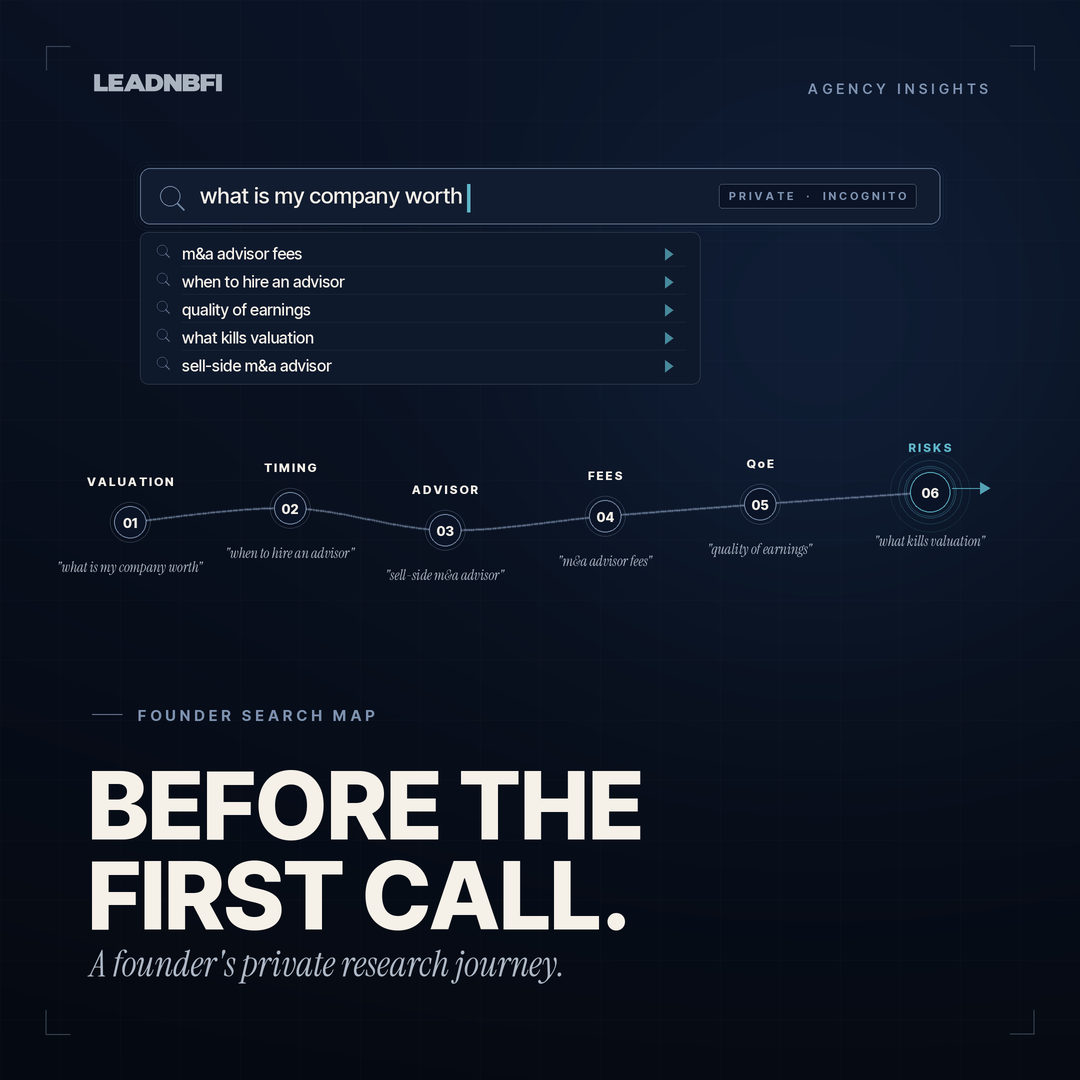
A founder selling a $10M–$100M business rarely types "M&A advisor" first.
That query comes late — after weeks of quieter research on valuation multiples, fee structures, buyer types, quality of earnings, and whether the business is even ready to go to market. By the time the founder is ready to shortlist advisors, the shortlist is already partly formed.
Most boutique M&A advisory sites miss that window entirely. They speak to the founder who has already decided — not the founder who is still figuring out what a sale actually looks like. That's the marketing gap.
This is a map of what founders search before hiring a sell-side M&A advisor, and where most advisor sites go dark.
The invisible research window
Between "I might sell someday" and "let me talk to advisors" there's usually 6–24 months of private research. Founders read, Google, and increasingly ask ChatGPT or Perplexity questions they won't ask their CFO — because the sale conversation is personal, political, and often confidential internally.
That's the invisible research window. It's where the shortlist quietly forms.
For advisors investing in marketing, the strategic point is this: ranking for "M&A advisor" is not the goal. Answering the questions founders type before they search for an advisor by name — that's the goal. Every unanswered question is a shortlist entry someone else earns.
The 6-stage founder search map
The queries fall into six clusters. Not linear — founders move between them based on what creates internal urgency — but each cluster has a distinct information need, and each has a corresponding gap on the average advisor site.
| Stage | What founders actually search | What typical advisor sites do | What the strong site does |
|---|---|---|---|
| 1. Should I sell? | Timing, readiness signals, market window, personal exit goals | Generic "sell-side process" page assuming decision already made | Dedicated sale-readiness section explaining triggers, prep timeline, and market signals |
| 2. What is my company worth? | EBITDA multiples, value drivers, comparable transactions | One-line "we maximize value" claim | Valuation explainer covering multiples, add-backs, and the levers that move enterprise value |
| 3. When do I hire an advisor? | Timing, sell-side vs. broker distinction, selection criteria | "Contact us" CTA too early, no decision framework | Explains the 12–24 month sale-readiness window and how advisor value shifts across it |
| 4. What does an advisor cost? | Retainers, success fees, Lehman variants, minimums, tail periods | Avoids fees entirely | Fee-logic page that explains structure honestly without publishing rigid numbers |
| 5. What kills valuation? | Customer concentration, owner dependency, add-back scrutiny, TTM softness | Says nothing about risk | Pre-sale diagnostic covering the top 8–10 discount drivers |
| 6. How do buyers diligence EBITDA? | QoE, normalized EBITDA, add-back defensibility, working capital peg | Uses jargon without translation | Diligence credibility section translating buy-side scrutiny into founder language |
Read that table as a marketing brief. Every row where a firm's site does the middle column and not the right column is a founder who moves on to the next advisor's site.
Stage 1 — "Should I sell?"
The earliest, softest stage. The founder is thinking about it, not planning it. Real queries:
- Should I sell my company now?
- How do I know if my business is ready to sell?
- What are the signs it's time to exit?
- How long should I plan a sale before starting?
- Should I fix the business first or sell as-is?
The typical advisor site skips this stage because it doesn't convert immediately. That's a mistake. This is where founders decide who earns the right to the shortlist call six months later.
What answering it looks like: a sale-readiness page or article cluster explaining the internal triggers (owner fatigue, generational transition, market timing, sector consolidation) and the operational triggers (recurring revenue mix, management depth, clean financials, TTM growth). Not a sales pitch — a diagnostic. Founders who read that page and see themselves reflected trust the advisor's judgment before the first call.
Stage 2 — "What is my company worth?"
Valuation is where founders get most anxious and where most advisor sites are weakest. Typical searches:
- What EBITDA multiple should I expect?
- How do buyers value a company like mine?
- What multiples are software companies trading at right now?
- Do buyers pay for growth or margin?
- How much does recurring revenue affect valuation?
The instinct on advisor sites is to say nothing specific about valuation to protect optionality. The problem is that founders read that silence as evasion, and go find the answers on PE blogs and diligence-firm content that speak plainly about EV/EBITDA ranges, sector multiples, and value drivers.
What answering it looks like: a valuation explainer that covers the mechanics without quoting a number for the reader's own business. Explain the difference between enterprise value and equity value. Walk through what add-backs are defensible (owner compensation above market, one-time legal costs, non-recurring capex) and what buyers reject (aspirational EBITDA, pro-forma synergies the seller assumes). Note that growth rate is often a bigger multiple driver than absolute EBITDA size in the $10M–$50M range. The founder doesn't need a number. They need to see the firm understands how a number gets built.
Stage 3 — "When do I hire an advisor?"
By the time founders search here, they're moving from curiosity to selection. This is where the head terms — how to choose an M&A advisor, sell-side M&A advisor, M&A advisor vs business broker — naturally live.
Common queries:
- When should I hire an M&A advisor?
- Do I need an advisor before I talk to buyers?
- What's the difference between an M&A advisor and a business broker?
- How do I choose a sell-side advisor?
- What does a sell-side M&A advisor actually do?
Most advisor sites answer "when to hire" implicitly ("contact us") and never address the sell-side-vs.-broker distinction — even though it's one of the most common queries at this stage. Business brokers typically handle sub-$5M deals, work on transaction volume, and rely on public listings. Sell-side M&A advisors run confidential, curated processes for $5M–$500M businesses. Founders search this distinction because they don't know which they need.
What answering it looks like: a page that maps the 12–24 month sale-readiness window and shows where advisor involvement changes outcome — pre-market preparation (financial cleanup, add-back documentation, management presentation), buyer universe development, and process execution. Not credentials. A decision framework.
Stage 4 — "What does an advisor cost?"
This is where advisor sites are most defensive and most punished for it. Founders search:
- What do M&A advisor fees look like?
- What is a typical success fee structure?
- How does a Lehman fee work?
- Do advisors charge a retainer?
- Are M&A advisor fees negotiable?
You don't need to publish a fee card. You do need to explain the logic. The strong site addresses the common structures directly: monthly retainers credited against the success fee at close, success fees calculated on the Modified Lehman scale (5% of the first million of consideration, 4% of the second, 3% of the third, 2% of the fourth, 1% of everything above), minimum success fees typical in the lower middle market ($500K–$1M is common), and tail provisions covering 12–24 months post-engagement to protect the advisor's work if a deal closes after termination.
Naming those mechanics does two things: it filters out founders looking for a discount broker, and it signals to the qualified founder that the firm is confident enough to speak plainly about how it gets paid. Both improve conversion quality.
Stage 5 — "What kills valuation?"
The founder has decided they're probably selling, and now they're worried. This cluster is where advisor sites can build enormous trust with almost no competition:
- What lowers my company's valuation?
- How much does customer concentration hurt value?
- Does owner dependency reduce sale price?
- What do buyers look for as risk?
- What's a typical valuation discount for a founder-dependent business?
The dominant risks are consistent across the lower middle market: customer concentration above 20–25% of revenue, owner dependency in sales or operations, a thin management bench, unaudited or reviewed-only financials, revenue quality issues (project vs. recurring, churn, cohort decay), TTM EBITDA declining into the process, and unresolved legal or regulatory overhangs.
What answering it looks like: a pre-sale diagnostic — page or article cluster — that walks through the eight to ten most common valuation-killers and explains how each typically gets discounted (a customer at 40% of revenue might cost one to two turns of EBITDA; owner dependency might cost half a turn to a full turn depending on the sale process). This is high-utility content a founder saves, shares with their CFO, and remembers when the shortlist gets made.
Stage 6 — "How do buyers diligence EBITDA?"
The technical-credibility stage — where the founder is trying to understand what will happen to their numbers in a real process. Queries:
- What is a Quality of Earnings report?
- How does QoE differ from an audit?
- What is normalized EBITDA?
- What is a working capital peg?
- What are add-backs and which ones survive diligence?
Advisor sites either say nothing here or use the jargon without translation, which alienates the exact founder they want to attract. The strong site translates: a Quality of Earnings is a buy-side (or increasingly sell-side) financial diligence exercise typically running $50K–$150K for lower middle market deals, performed by boutiques like CBIZ, EisnerAmper, or Aprio, or by the Big Four on larger transactions. The working capital peg is the average net working capital the buyer expects to receive at close — usually a 12-month trailing average — and dollar-for-dollar shortfalls reduce the purchase price at closing. Add-backs are legitimate normalizations of one-time or non-recurring costs, and buyers routinely challenge anything that looks aggressive.
What answering it looks like: a diligence credibility section — likely a supporting article rather than a top-nav page — that walks through the diligence workflow in plain language. Founders who understand what's coming go into the process calmer, which is a genuine service the advisor can market.
What typical advisor sites get wrong
Zoom out and the pattern is consistent: advisor sites are written from the firm's point of view (credentials, sectors, process, tombstones) instead of the founder's (should I sell, what's it worth, what will it cost, what could kill it). The problem is rarely content quality. It's content architecture.
A stronger structure typically includes:
- A sell-side advisory page explaining role, timing, and fit
- A sale-readiness section for pre-decision founders
- A valuation explainer covering multiples, drivers, and add-back logic
- A fees page that removes friction by explaining structure
- A pre-sale diagnostic cluster covering valuation-killers
- A diligence credibility section translating QoE and working capital mechanics
- Supporting articles on buyer types, earn-outs, rollover equity, and confidentiality
Marketing for M&A advisors becomes strategic — not cosmetic — the moment the site is built around founder search behavior instead of firm self-description.
Every unanswered question is a competitor's opening
The founder who can't find answers on one advisor's site does not stop searching. They keep going — to another firm, another blog, or an AI summary that pulls from whoever did answer. That summary shapes the shortlist.
The advisor whose site answers those questions first doesn't just rank better. They enter the founder's mental shortlist before the first outreach ever happens. That's what marketing for M&A advisors is actually for.
Turn founder questions into qualified conversations
If your advisory site is written from the firm's point of view instead of the founder's, LeadNBFI can help you rebuild content, structure, and SEO and GEO around what founders actually search — so the shortlist forms with your name on it.
FAQ
What should marketing for M&A advisors focus on first? Content architecture. A boutique advisor's site should answer the six question clusters founders search before hiring: sale-readiness, valuation, timing, fees, valuation-killers, and diligence mechanics. Rewriting home page copy without fixing the underlying architecture is cosmetic.
How do M&A advisor fees actually work? Most boutique sell-side engagements combine a monthly retainer (often credited against the success fee at close), a success fee on a Modified Lehman scale (5-4-3-2-1%), a minimum success fee ($500K–$1M is typical in the lower middle market), and a 12–24 month tail provision covering post-engagement closings.
When should a founder hire a sell-side M&A advisor? For a $10M–$100M business, 12–24 months before going to market is typical. That window covers financial cleanup, add-back documentation, management team development, and buyer universe research — all of which materially affect final proceeds.
What kills valuation most often in a middle-market sale? Customer concentration above 20–25% of revenue, owner dependency in sales or operations, unaudited financials, declining TTM EBITDA into the process, and unresolved legal or regulatory issues. Each can cost half a turn to two turns of EBITDA depending on severity.
How does LeadNBFI help with marketing for M&A advisors? LeadNBFI rebuilds M&A advisory websites and content around founder search behavior, improves SEO and GEO visibility, and creates the finance-native content that positions boutique firms as credible before the first call.